


Cat Fountain Bacteria: Why It Grows & How to Stop It
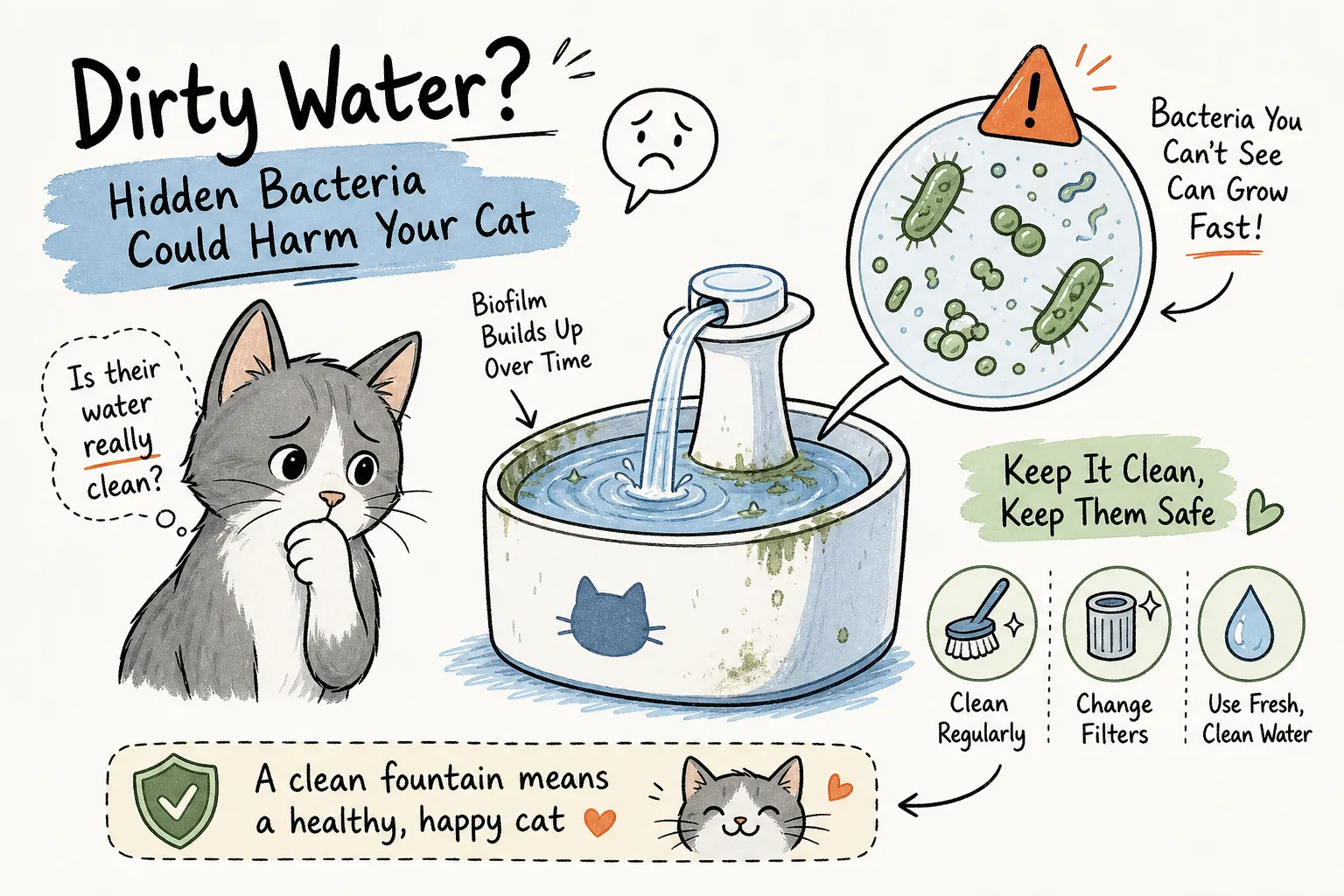
You clean your cat's fountain on a Sunday. By Wednesday, there's a slimy pink film clinging to the sides again. The water looks questionable, your cat seems hesitant to drink, and you're wondering whether the whole thing is doing more harm than good. Cat fountain bacteria is the documented culprit here, and this isn't a cosmetic problem or a cleaning failure on your part.
Bacterial biofilm in cat fountains has a specific cause rooted in fountain design, not owner negligence. Most cat owners who experience this cycle are fighting the architecture of their fountain, not just the dirt inside it. That distinction matters enormously for how you approach a solution.
This guide covers the actual bacteria involved, why conventional fountain designs are structurally set up for contamination, what filters can and can't do, how materials affect bacterial colonization, and what a genuinely effective cleaning routine looks like. If you've ever wondered whether there's a better answer than scrubbing the same parts every week, that question gets addressed too.
The Bacteria Actually Living in Your Cat's Fountain
The Pink Slime Culprit: Serratia marcescens
That pink or reddish-orange film is caused by Serratia marcescens, an airborne bacterium that thrives on moist, nutrient-rich surfaces. It travels through the air, lands on wet fountain walls, and anchors itself into a protective biofilm matrix. Once embedded, it becomes increasingly resistant to casual rinsing because the matrix physically shields the bacterial colony from cleaning agents that don't penetrate it.
Serratia marcescens isn't just unsightly. It spreads directly into the water your cat drinks. For healthy adult cats, a single exposure is unlikely to cause serious illness, but repeated ingestion from a chronically contaminated water source is a different matter. The bacteria don't disappear between cleanings; they rebuild from whatever colonies survived.
Other Pathogens That Share the Same Wet Environment
Pseudomonas aeruginosa, E. coli, Salmonella, and Staphylococcus have all been identified in poorly maintained pet water fountains. The associated health risks for cats range from gastrointestinal illness (vomiting, diarrhea) to urinary tract problems and skin irritation. Chin acne in cats, a condition many owners attribute to allergies, is frequently linked to bacteria-harboring plastic bowl and fountain surfaces.
Immunocompromised cats, kittens, and senior cats face a higher risk from Pseudomonas specifically, since it's an opportunistic pathogen that can cause more serious infections in animals whose immune systems are already under stress. The goal here isn't alarm; it's accuracy. The risks are real, they're proportionate to how contaminated the water source becomes, and they're preventable with the right information.
Cat Fountain Bacteria: How Biofilm Forms in Recirculating Designs
Biofilm Forms Faster Than Most Owners Expect
Bacterial attachment to wet surfaces begins within hours. A visible slime matrix often develops within one to three days, depending on temperature, the presence of saliva and food particles, and how much stagnant space exists inside the fountain housing. Warmer rooms, heavier fountain use, and plastic micro-scratches all accelerate the timeline significantly.
Those micro-scratches matter more than most owners realize. Repeated scrubbing of a plastic fountain gradually creates tiny grooves in the surface. Bacteria settle into those grooves, where cleaning tools can't fully reach them. This is why a fountain that was perfectly clean a year ago becomes harder to clean with every passing month, even if your routine hasn't changed.
The Recirculation Problem Conventional Fountains Can't Escape
In most conventional recirculating cat fountains, regardless of price point, the pump sits inside the same body of water the cat drinks from. Every time the pump runs, it churns saliva, food residue, shed hair, and bacteria together and cycles that water back through the same chamber. Every internal surface receives a constant coating of this mixture, and biofilm rebuilds between cleanings because the conditions for it never stop existing.
This isn't a flaw unique to inexpensive models. It's baked into the recirculating design itself. A $20 fountain and a $90 fountain from a well-known brand share this same structural vulnerability. The contamination pathway is identical regardless of what the marketing says. The AquaOne from Purestream was designed around this specific insight: according to manufacturer specifications, its sealed dual-chamber architecture keeps clean source water physically isolated from used water and the pump, so the contamination pathway is structurally reduced rather than just made harder to manage.
Why Your Fountain Filter Can't Solve a Bacteria Problem
What Activated Carbon Actually Filters (and What It Doesn't)
Activated carbon and charcoal filters do a few things well. They reduce chlorine, improve taste, and cut down on odor. They are not designed to remove or kill bacteria, and they don't do so reliably. Independent testing of filtered pet water fountains has found no significant bacterial reduction attributable to the filter alone, and in some cases bacterial counts actually increased over time as the cartridge accumulated organic matter from the fountain water.
Antimicrobial or silver-treated filter media can suppress bacterial growth within the cartridge itself, but this is growth suppression, not disinfection. The water passing through the cartridge isn't meaningfully sterilized. A filter that's reducing your fountain's chlorine taste is doing its job; expecting it to function as a bacteria barrier is asking it to do something it was never built for.
When a Neglected Filter Makes the Water Worse
Activated carbon cartridges should be replaced every two to four weeks for most cat fountains, and even sooner in high-use multi-cat households, in line with most manufacturer and veterinary guidance. Past that window, the cartridge loads up with saliva residue, organic material, and bacteria. At that point, the filter isn't cleaning the water; it's actively shedding contaminants into it. The very component meant to improve water quality becomes another colonized surface.
Fountain filter replacement on this schedule typically adds $30 to $100 per year in ongoing costs, depending on the fountain model and filter brand (based on average filter prices and a replacement frequency of every two to four weeks). That expense doesn't eliminate the bacterial root cause; it keeps contamination from the filter cartridge at a slightly slower pace. It's worth noting that the AquaOne's filterless architecture removes this ongoing cost and this problem entirely by addressing the contamination pathway structurally rather than managing it through consumables that expire.
How Fountain Material Affects Bacterial Colonization
Why Plastic Is the Worst Surface for Pet Water Hygiene
Plastic scratches during normal use and cleaning, and those scratches create protected recesses where bacteria anchor and multiply beyond the reach of scrubbing. The surface degrades progressively, which means a plastic fountain becomes harder to clean the longer it's in service, even with a consistent routine. Comparative testing of pet bowl materials generally finds that plastic retains higher bacterial counts after repeated use than stainless steel or intact glazed ceramic, particularly once the surface is scratched, though research in this specific area continues to develop and results vary across studies.
Plastic fountain surfaces are also directly linked to feline chin acne, a bacterially driven skin condition. When cats press their chins against a scratched plastic fountain to drink, bacteria transfer to the skin and follicles. Switching to a non-porous material is frequently the first recommendation for cats who develop recurring chin acne. Disinfecting cat water dispensers made of plastic is also more difficult and less reliable than cleaning non-porous alternatives, for exactly this reason.
Stainless Steel and Ceramic: What the Evidence Actually Says
Stainless steel is non-porous, durable, and tolerates thorough washing and higher-temperature cleaning without surface degradation. Veterinary guidance on pet hygiene consistently describes stainless steel as significantly easier to sanitize than scratched plastic. Well-glazed, high-fired ceramic performs comparably when the surface is intact, but chips or cracks in the glaze create bacterial hiding spots that undermine that advantage quickly.
The practical conclusion isn't that stainless steel is always bacterially sterile; it's that smooth, non-porous surfaces are structurally harder for biofilm to colonize and easier to fully clean. This is the functional rationale behind the AquaOne's 304 stainless steel drinking tray. It's the only surface the cat contacts, and it's a material choice made specifically because it doesn't harbor bacteria the way scratched plastic does.
A Vet-Safe Cleaning Routine That Actually Reduces Contamination
The Right Cleaners and Safe Concentrations to Use
Three approaches cover the full range of routine and deep cleaning for conventional cat fountains. Mild, unscented, dye-free dish soap in warm water is the baseline for weekly scrubbing of all removable parts. Diluted white vinegar (1:1 or 1:3 with water) is the right tool for soaking non-electrical parts and dissolving mineral deposits; allow a 10- to 15-minute soak, then rinse thoroughly. For monthly disinfection, a 3% hydrogen peroxide solution applied to non-electronic parts and followed by complete rinsing handles sanitizing without leaving residue that deters cats from drinking.
A few important warnings: never mix vinegar with bleach or hydrogen peroxide. Vinegar and bleach together produce irritant chlorine compounds; vinegar and hydrogen peroxide together create peracetic acid, a corrosive irritant.
Avoid scented soaps, antibacterial dish soaps, and any cleaner containing phenol or essential oils near fountain surfaces. Cats are sensitive to residues that humans don't notice, and a fountain that smells like soap or citrus to your cat is a fountain your cat may stop using.
Stopping Cat Fountain Bacteria: A Cleaning Schedule Most Owners Can Actually Follow
A realistic maintenance cadence for a conventional recirculating fountain looks like this:
- Daily: rinse the drinking surface with fresh water
- Weekly: full disassembly, scrub all parts with dish soap and warm water, rinse thoroughly
- Every two weeks: soak non-electrical parts in diluted vinegar for mineral deposits, then rinse completely
- Every two to four weeks: replace the filter cartridge
- Monthly: 3% hydrogen peroxide disinfection of non-electronic components, followed by complete rinsing and drying
Full disassembly and scrubbing for most conventional fountains takes roughly 20 to 25 minutes per session based on typical user experience, not a worst-case estimate. For multi-cat households, the timeline compresses because higher usage accelerates biofilm development and the cleaning interval has to shorten to compensate. This routine is the most effective available approach for a conventional fountain, and it genuinely works when followed consistently. The honest caveat is that even consistent execution is managing a recurring problem, not solving its source.
The Architectural Answer to the Root Cause
Why Cleaning Routines Treat Symptoms, Not Structure
Conventional fountains recirculate contaminated water through the pump housing, biofilm begins rebuilding within 24 hours of a full cleaning, filters don't remove bacteria and eventually become contamination sources themselves, and plastic surfaces harbor bacteria in micro-scratches that cleaning can't fully reach. Even a diligent owner running the full cleaning schedule above is working against the design every single week. The cat fountain bacteria problem in most recirculating designs is structural, not behavioral. That framing changes what an actual solution looks like.
How the AquaOne's Sealed Dual-Chamber Changes the Equation
According to Purestream's product specifications, the AquaOne keeps 2.6 liters of clean source water physically isolated in a sealed chamber, completely separated from the wastewater zone at all times. The pump lives inside the clean-water tank and, by design, never contacts saliva, shed hair, or biofilm from the drinking area. Water is dispensed fresh to the 304 stainless steel drinking tray on a programmed schedule and does not recirculate back through the system.
Removing recirculation greatly reduces the primary pathways for biofilm spread, though any surface that remains persistently wet can still support some biofilm formation, and regular cleaning remains good practice. Without a filter cartridge, there's no aging media to become a bacterial colony. The result is a fountain designed to reduce contamination structurally rather than slow it through better cleaning or better filters. According to manufacturer information, the simplified design may reduce weekly cleaning time and limit pump exposure to contaminated water compared with typical recirculating designs. For owners who have cycled through multiple conventional fountains and keep landing in the same place, the AquaOne represents a different category of product rather than an incremental improvement on the same idea.
The Design Problem Behind the Dirty Water
Cat fountain bacteria growth is a design problem, not a cleaning failure. Serratia marcescens and other pathogens colonize recirculating fountains rapidly because every conventional recirculating fountain gives them exactly what they need: a warm, moist, saliva-rich environment with constant agitation to distribute bacteria across every surface. Filters don't stop this process and can accelerate it when they go past their replacement date. Plastic surfaces make the problem progressively worse as micro-scratches accumulate.
For cat owners who want to stay with a conventional fountain, the vet-safe cleaning routine in this guide is the most effective available approach. Follow it consistently and it will meaningfully reduce contamination, even if it can't eliminate the underlying vulnerability. If your cat shows any signs of illness, check with your vet, recurring gastrointestinal issues or chin acne can sometimes point back to the water source. For owners who are done managing the same problem every week, the AquaOne's sealed dual-chamber design is built to address the root cause by reducing the recirculation architecture that makes bacterial contamination structurally hard to escape.
To see how the design works and whether it fits your household, explore the AquaOne at Purestream. The product page walks through the chamber architecture in detail, and the Purestream team is available to answer questions before you decide.